

Cold rooms protect food, medicines, dairy products, flowers, chemicals, and other temperature-sensitive goods. A small component failure can interrupt cooling and place an entire inventory at risk.
Contractors selecting spare parts for cold room in Nagpur should focus on criticality, compatibility, and replacement readiness rather than waiting for every component to fail before arranging a purchase.
Identify Components That Can Stop Cooling
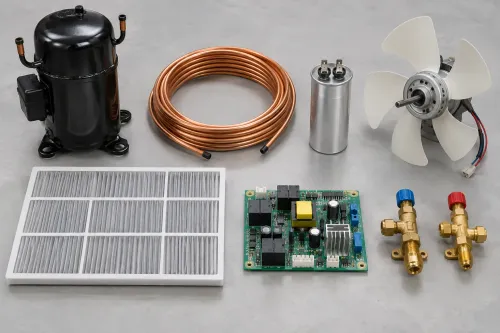
Some failures cause an immediate shutdown, while others gradually reduce efficiency. The most critical parts usually include compressor controls, contactors, overload protectors, fan motors, pressure switches, solenoid valves, and temperature controllers.
A useful maintenance review should cover:
- Condensing unit components
- Evaporator fans and motors
- Defrost heaters and timers
- Thermostats and digital controllers
- Pressure and temperature sensors
- Expansion valves
- Solenoid valves and coils
- Filter driers
- Door heaters and gaskets
- Refrigerant and refrigeration oil
The appropriate stock list depends on the room temperature, system capacity, refrigerant, operating schedule, and value of the stored goods.
Separate Critical Spares From Routine Consumables
Critical spares are components whose failure can stop the system and which may not be available immediately. Routine consumables are items frequently needed during maintenance.
A facility may keep contactors, fuses, controller sensors, fan capacitors, solenoid coils, and filter driers on site. Expensive components such as compressors or specialised electronic controllers may be stocked only when downtime risk justifies the investment.
The decision should consider the supplier’s availability, delivery time, equipment age, and presence of standby refrigeration.
Diagnose the Cause, Not Only the Failed Part
Repeated component failure usually indicates an unresolved operating condition. A contactor may burn because of loose terminals or excessive current. A fan motor may fail because ice obstructs the blade. A compressor may overheat because the condenser is dirty or the refrigerant charge is incorrect.
Before replacing a part, check:
- Supply voltage and phase balance
- Operating pressures
- Airflow through both coils
- Refrigerant leaks
- Oil condition
- Electrical connections
- Controller settings
- Door-closing performance
- Defrost operation
This prevents the new component from being exposed to the same damaging condition.
Plan for Nagpur’s Summer Conditions
High outdoor temperatures in Nagpur can increase condenser pressure, particularly where condensing units have restricted ventilation or dirty coils. Cold-room systems may operate for longer periods during peak summer, making preventive maintenance especially important.
Contractors should inspect condenser cleanliness, fan performance, refrigerant condition, compressor current, and electrical terminals before seasonal demand reaches its highest level.
Review Compatibility Before Ordering
The old component should be identified through its model code, electrical rating, pressure range, connection size, refrigerant compatibility, and capacity.
For controllers, note the sensor type and number of outputs. For expansion valves, confirm capacity, refrigerant, equalisation method, and connection size. For fan motors, compare speed, wattage, mounting, rotation, and temperature suitability.
Cool Care Corporation can assist refrigeration professionals in Nagpur with specification-based sourcing across commonly required cold-room components. Providing equipment photographs, nameplate details, and existing part codes helps the provider identify appropriate options more efficiently.
A well-planned spare-parts strategy reduces emergency searching, supports faster repairs, and helps protect valuable stock. For cold storage operators across Maharashtra, readiness is not simply keeping many parts it is keeping the right critical parts for the installed equipment.