

A capillary tube that works in a compact freezer can starve a cold room, while a correctly sized TXV can still perform poorly if hot-weather condensing pressure causes flash gas at its inlet. By the end, you will be able to match the control type to the refrigeration application, read a capacity table, and specify the valve and installation details a supplier must confirm.
Key takeaways
- Choose TXVs for stable superheat control across changing refrigeration loads.
- Use EEVs when electronic control justifies sensors, wiring and commissioning time.
- Match valve capacity to refrigerant, evaporating conditions and design load—not pipe diameter.
- Confirm operating data, controller compatibility and commissioning support before purchase.
How TXVs, EEVs, Capillary Tubes, Fixed Orifices and AEVs Control Refrigerant
A TXV meters refrigerant to maintain evaporator-outlet superheat; an EEV does the same through a stepper motor and controller. A capillary tube or fixed orifice provides a constant restriction, while an AEV regulates evaporator inlet pressure rather than outlet superheat.
| Type | Control method | Right choice |
|---|---|---|
| TXV | Sensing bulb and equalizer adjust flow mechanically | Cold rooms, display cases, frozen-food freezers and air-conditioning units with changing loads |
| EEV | Controller drives a stepper motor for precise, rapid flow changes | Water chillers, process cooling, transport refrigeration and systems with wide load or condensing-pressure changes |
| Capillary tube | Fixed bore; flow depends on pressure difference, charge and subcooling | Small, sealed systems with stable load, short pipe runs and controlled operating conditions |
| Fixed orifice | Fixed metering opening, usually simpler and more serviceable than an adjustable valve | Packaged air-conditioners or refrigeration circuits designed around one refrigerant and operating range |
| AEV | Adjusts flow to hold a set evaporator pressure | Systems needing pressure limitation and fairly steady load, not precise superheat control |
For a refrigeration expansion valve comparison in Nagpur, match the device to refrigerant, evaporating temperature, design condensing pressure, capacity, liquid temperature, available pressure drop and distributor loss. A capillary tube becomes a poor choice when outdoor temperature, condensing pressure or load varies; it cannot correct its own feed rate.
A TXV needs an external equalizer when distributor or evaporator pressure loss is significant, or it can starve the coil. A flooded evaporator uses a float valve to maintain liquid level, not a TXV’s superheat principle. These are the key differences among expansion valve types in Nagpur.
TXV or EEV: Choosing Superheat Control for Variable Loads
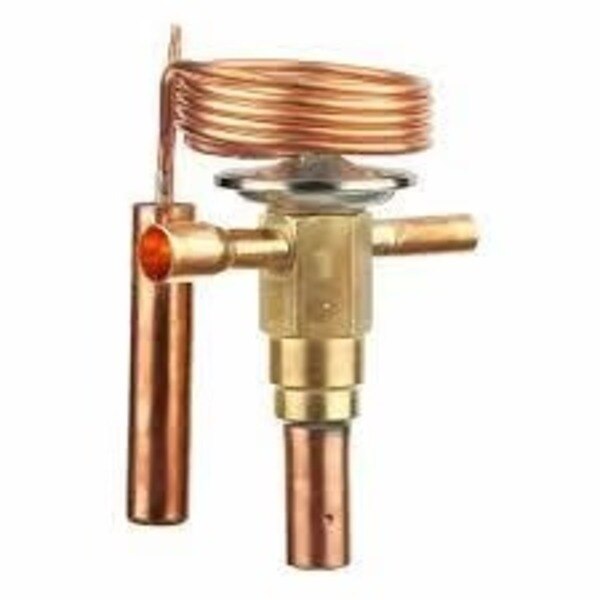
Choose a TXV instead of an EEV when the evaporator is dry-expansion, load changes are moderate, and you need reliable superheat control without a controller or continuous power supply. A TXV uses a sensing bulb and diaphragm; an EEV uses a motor-driven needle commanded by sensors and software.
| Option | Control method | Choose it when |
|---|---|---|
| TXV | Bulb senses outlet superheat and modulates refrigerant flow | The system needs simple, self-contained control with moderate load variation |
| EEV | Stepper motor responds to a controller’s superheat calculation | Load changes rapidly, compressors stage or vary speed, or remote optimisation matters |
A TXV does not directly control evaporator capacity. Compressor capacity, evaporating pressure, condensing pressure, and heat load determine capacity while the valve maintains outlet superheat. That makes it a strong choice for cold rooms, standard air conditioners, and stable process loads, but not automatically for every freezer.
In a refrigeration expansion valve comparison, choose a TXV when these conditions apply:
- The system has no control panel or reliable power at the valve.
- Load swings are predictable and compressor cycling is limited.
- You can select the correct bulb charge for the refrigerant and evaporating-temperature range.
- The evaporator is dry expansion, not flooded; a float valve controls liquid level in a flooded evaporator.
- The available pressure drop and distributor loss match the manufacturer’s capacity table.
Use an EEV for fast pull-down, wide load variation, low-temperature control, or close compressor protection. An incorrectly charged TXV can cause high superheat or liquid floodback.
Best Expansion Device for Cold Rooms, Freezers, Chillers and Other Systems
Match the device to load behaviour, evaporating temperature and control method—not nominal connection size. These expansion valves compared for refrigeration applications in Nagpur must account for high summer condensing pressure, available pressure drop, liquid subcooling and distributor pressure loss.
| Application | Preferred device | Why it fits |
|---|---|---|
| Cold room | TXV | Maintains outlet superheat as stored-product load changes; select the refrigerant-specific low- or medium-temperature model. |
| Frozen-food freezer | TXV or EEV | Use a low-temperature valve matched to evaporator pressure, allowable superheat, compressor envelope and defrost cycle. A chiller valve is not automatically suitable. |
| Display case | EEV | Handles frequent door-opening and product-load changes while coordinating with rack controls and head-pressure management. |
| Ice machine | TXV or fixed orifice | A TXV suits changing ambient conditions; a fixed device suits a stable, factory-defined cycle. |
| Water chiller | TXV or EEV | TXV suits steady commercial loads; EEV suits variable leaving-water temperature, compressor staging and low-load operation. |
| Process cooling | EEV | Rapid modulation protects a narrow process temperature band, provided a controller and power supply are available. |
| Transport refrigeration | EEV or TXV | EEV responds to changing speed, ambient and cargo load; TXV remains practical where controls must stay simple. |
| Room air conditioner | Capillary tube, fixed orifice, TXV or EEV | Small fixed devices suit stable packaged units; TXV or EEV is better for variable-speed compressors and changing Nagpur conditions. |
An automatic expansion valve suits a limited-load system requiring nearly constant evaporator pressure, not a variable-load cold room. A float valve belongs with a flooded evaporator because it regulates liquid level; a TXV regulates dry-evaporator outlet superheat. That distinction defines useful expansion valve types in Nagpur.
How to Select Valve Capacity Without Mistaking Pipe Size for Performance
Select the valve from the required refrigeration capacity at actual operating conditions, not from the liquid-line connection size. Record these inputs before opening a manufacturer’s capacity table:
- Refrigerant and evaporator type
- Required capacity in kW or tonnes of refrigeration
- Evaporating temperature or pressure
- Design condensing temperature or pressure
- Liquid temperature at the valve, including subcooling
- Pressure drop available across the valve
- Evaporator distributor and circuit pressure loss
| Manufacturer table entry | What to verify | Why it changes selection |
|---|---|---|
| Refrigerant | Match the exact refrigerant column | R134a, R404A, R448A and R410A produce different capacities |
| Evaporating temperature | Use the design evaporating condition | Valve capacity changes with evaporator pressure |
| Condensing pressure | Use the design, not average, condition | It determines inlet pressure and available pressure drop |
| Liquid temperature | Apply the stated subcooling or liquid-temperature condition | Flash gas at the inlet reduces feeding capacity |
| Pressure drop | Subtract distributor and line losses | A valve rated at 1 MPa drop may underfeed at 0.3 MPa |
| Required capacity | Select above the calculated load without oversizing heavily | An oversized TXV can hunt and lose stable superheat control |
Read the table at the nearest actual conditions and apply the manufacturer’s correction factors; do not use its headline capacity. Two valves with identical connections can have different port capacities.
For a dry-expansion evaporator, a TXV is sized to maintain outlet superheat. A float valve instead controls liquid level in a flooded evaporator, so a refrigeration expansion valve comparison based only on nominal capacity is misleading.
This matters in expansion valves compared for refrigeration applications in Nagpur, where high ambient condensing pressure can sharply reduce available pressure drop.
The Purchase and Commissioning Checklist for Nagpur Installations
Do not approve a valve from its nominal pipe diameter alone. Before buying, give the HVAC expansion valves supplier in Nagpur the design refrigerant, evaporating temperature, condensing pressure for Nagpur’s peak ambient, refrigeration capacity, liquid temperature, subcooling, available pressure drop, and evaporator-distributor pressure loss.
1. Record the exact manufacturer model and confirm approval for the specified refrigerant, including blends that require a different capacity rating.
2. Obtain the manufacturer’s capacity table for that refrigerant and operating point. Check the rated pressure range, connection type and size, flow direction, equalizer requirement, inlet strainer or filter requirement, bulb charge, and replacement power-element part number.
3. Confirm that the valve’s pressure rating exceeds the system’s design high-side pressure. Match flare, solder, or brazed connections to the pipework; do not force an adapter into a mismatched installation.
4. During installation, clamp the sensing bulb firmly to a clean outlet-pipe surface, insulate it, and keep it away from liquid traps. Connect the external equalizer to the correct point when the valve requires one.
5. Pressure-test with dry nitrogen, remove brazing debris, replace or clean the inlet filter, evacuate to the equipment manufacturer’s target, and verify there is no moisture indication before charging.
6. Commission under stable load: measure suction pressure, evaporator outlet temperature, superheat, liquid-line temperature, and subcooling. Adjust only after airflow or product load stabilises; record the final setting and model.
Cool Care Corporation can help compare a specified model against the actual operating data rather than supplying an unidentified replacement.
Related product
 | Expansion Valves Material N/A Usage/Application N/A Pressure N/A Valve Size N/A Brand N/A Media N/A Model Name/Number N/A Size N/A Color N/A Ambient Temperature N/A... View product → |
Frequently asked questions
How do TXVs, EEVs, capillary tubes, fixed orifices and AEVs differ?
TXVs regulate refrigerant using evaporator-outlet superheat, while EEVs use a stepper motor and controller for the same goal. Capillary tubes and fixed orifices provide a constant restriction. AEVs regulate evaporator inlet pressure rather than outlet superheat.
Should you choose a TXV or EEV for variable refrigeration loads?
Choose a TXV when mechanical superheat control meets the system’s load range. Choose an EEV when tighter electronic control and load response justify sensors, wiring, a controller and more involved commissioning.
Which expansion device suits cold rooms, freezers and chillers?
Compare the device with the system’s load variation, evaporating temperature, refrigerant and control requirements. TXVs and EEVs suit systems needing superheat control; capillary tubes and fixed orifices suit simpler fixed-load designs; AEVs suit systems requiring evaporator inlet-pressure regulation.
How do you select expansion valve capacity without using pipe size?
Select capacity from the refrigerant, design evaporating and condensing conditions, pressure drop, required load and superheat range. Pipe diameter carries refrigerant; it does not establish the valve’s metering capacity.
What should you check before commissioning a refrigeration expansion device in Nagpur?
Confirm the refrigerant, rated capacity, operating temperatures, connection details, controller and sensor compatibility, installation orientation, filter-drier condition and commissioning measurements. Record superheat, pressures and temperatures during startup.